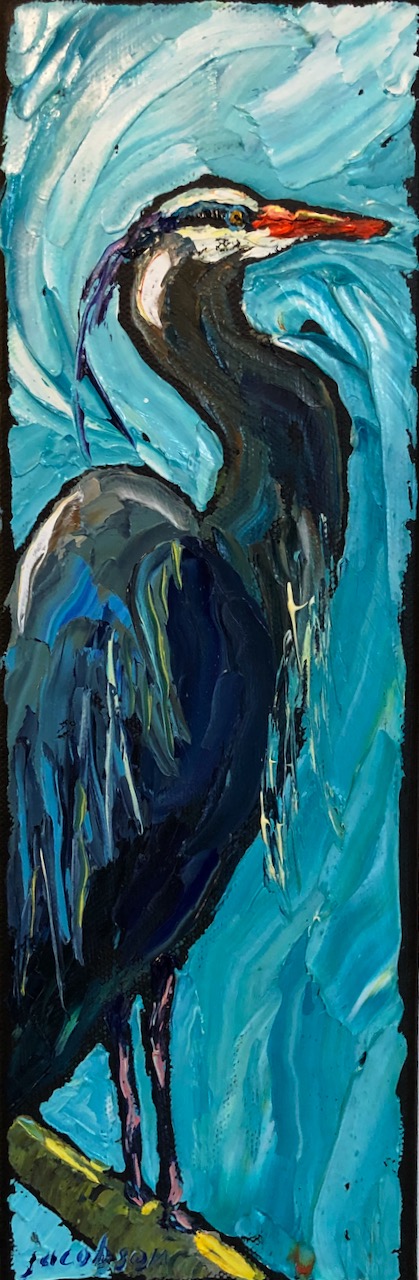
Wednesday, March 3, 2021
House Sparrow
Wednesday, February 10, 2021
Nuthatch, Perched
Monday, January 25, 2021
Magpie on a Curved Branch
Wednesday, January 20, 2021
Hawk
Tuesday, January 19, 2021
Bald Eagle
Monday, January 18, 2021
White Hawk
It's going nowhere, and I -- from nowhere.
Everything ironed flat, pleated without a wrinkle:
Miraculous, the breathing plain.
Meanwhile, the sun squints at the starched poverty --
The squint itself, consoled, at ease ...
The ten-fold forest almost the same ...
And snow crunches in the eyes, innocent, like clean bread.
Thursday, January 14, 2021
First Robin of Spring
Wednesday, January 13, 2021
Carolina Wren
Monday, November 16, 2020
Ms. Cardinal
sold!
I'M UP BY 5, usually, and I sit here at the kitchen table, next to an east-facing window, and I write, and wait for the sky to lighten. There have been mornings, many of them this year, in which it seemed that, for sure, the sun would not come up. The night would stretch out farther and farther, and I would look at the clock and the sky again and again and wonder if today would be the day. And then, of course, the sky would lighten, and the world would be set right again.
I like the time change, the earlier dawns, and even the earlier dusks. Right after Peter died, the days could not end early enough for me, and even now, there are many days in which I welcome the darkness, and I close the curtains and feel safe and shut in, and glad that the day is over.
Here in Wachapreague, sunset starts to come later on Dec. 7. It is by seconds at first, two seconds, then five, then 12, incremental, unnoticeable, largely unnoticed. Sunrise, however, continues to come later - by large parts of minutes - until Jan. 7.
So I will look out the window, those early January days, and surely, on one or two of them, I will wonder - is it today?
***
Coda
"One can have no smaller or greater mastery than mastery of oneself."
- Leonardo DaVinci
Monday, November 2, 2020
Crow Flying
Monday, October 26, 2020
Sunday, October 18, 2020
Wednesday, October 14, 2020
Tuesday, October 13, 2020
Monday, October 5, 2020
Blue Jay
(I've been having trouble with the PayPal buttons, so if you want to buy this lovely little bluejay and the button doesn't work, please email me at carrieBjacobson@gmail.com!)
THE SUMMER'S HUMMINGBIRDS left on Thursday. I put new nectar out at the start of the week, and I saw hummers at the feeders through Wednesday, and then - none.
They were my friends and companions here all summer, humming around my head, entertaining me with their antics at the feeder, amazing me with their speed and agility.
How I miss them!
Saturday is the one-year anniversary of Peter's death. When the hummingbirds left, it felt like they took summer with them. When he died, it felt like he took everything with him.
So I am going away, with my friend Carol and her mother, to a clean Air B&B where we stay every year during the show in Crozet. There's no show, but we had the reservation, and so we are going anyways. He would be proud of me.
***
A Final Thought
Thank You
Sunday, October 4, 2020
Thursday, October 1, 2020
Canada Goose Revisited
Monday, September 28, 2020
Hummer by Orange Flowers
This bird has flown!
HERE ARE SOME FUN FACTS about hummingbirds, from Kaytee.com
- They are the smallest migrating bird, but don't migrate in flocks. Typically, a hummer will travel alone for up to 500 miles at a stretch.
- The name comes from the humming noise their wings make.
- They're the only birds that can fly backwards.
- Hummingbirds have no sense of smell, but have great color vision. Different varieties prefer different colored flowers. The ruby-throated hummer likes orange or red flowers best - but red dye should not be used in nectar as it could harm the birds. Instead, plant naturally red or orange flowers or use feeders that have red coloring in their structure.
- Your average hummingbird weighs less than a nickel.
- They use their legs only for perching and moving sideways on a perch. They can't walk or hop.
- A hummer drinks from a feeder by moving its tongue in and out - about 13 times a second. That hummer can drink double its body weight in a day.
- The female typically lays two eggs only. They're about the size of jellybeans, and have been found in nests smaller than a half-dollar. Some varieties, like the black-chinned hummingbird, make nests with plant down, spider silk or other materials that can expand as their babies grow.
- A group of hummers can be referred to as a flock, a bouquet, a glittering, a hover, a shimmer or a tune.
- There are more than 330 species of hummingbirds in North and South America!
For more, see https://www.kaytee.com/learn-care/wild-bird/hummingbird-facts.
***
A Last Thought
"If you have talent, use it in every which way possible. Do not hoard it. Do not dole it out like a miser. Spend it lavishly like a millionaire intent on going broke."
- Brenda Francis